

Issue No. 7 · October 11, 2026

Old Book Hunter #7

A little paean to my vegetarian friends. For most of history, growing vegetables wasn’t a hobby. It was how you avoided going hungry. Somewhere between Versailles and Philadelphia that began to change, and this issue traces how. We start with Louis XIV’s gardener, a lawyer who learned to make figs ripen in June and asparagus appear in December, and whose son published his secrets after his death. We visit John Evelyn at 79, writing the first English book devoted to salad and fussing over which knife won’t bruise the leaves. We meet a best-selling gardening author who paid another man twenty guineas to put his name on the cover. We follow Parmentier’s long campaign to persuade the French that the potato was food, not pig feed, a campaign that included royal buttonholes, an all-potato dinner for Benjamin Franklin, and a field left unguarded so Parisians would steal from it. And we end in Philadelphia, where an Irish seedsman rewrote the gardener’s calendar for American weather and grew Lewis and Clark’s seeds for Thomas Jefferson. Five books, spanning a little over a century, all asking the same question: what should we plant, and when?

[ THE BARGAIN ]
Every Man His Own Gardener. Being a New, and More Complete Gardener's Kalendar than any one hitherto published

Every Man His Own Gardener. Being a New, and More Complete Gardener's Kalendar than any one hitherto published

Thomas Mawe [i.e. John Abercrombie] · 1773

$239

One of the most successful English gardening manuals of the eighteenth century, issued month-by-month as a working calendar and reprinted for decades after its first 1767 appearance. The title-page attribution to Thomas Mawe is a publisher's device: the text was written by the Scottish gardener John Abercrombie, whose name was added to the title only from the seventh edition of 1776, making the 1773 sixth edition the last to carry Mawe's name alone. The title is the whole point. This was gardening written for everyone, not for dukes, and it became the best-selling gardening book of its century, revised for more than a hundred years. The name on the title page, though, is a fiction. John Abercrombie was the son of an Edinburgh market gardener who had worked at Kew and run his own nursery but was unknown to the reading public. His publisher arranged for Thomas Mawe, gardener to the Duke of Leeds, to lend his more famous name, for twenty guineas. When Abercrombie later visited Mawe in Yorkshire, he found a man so powdered and so laden with gold lace that he thought he was meeting the Duke himself. Abercrombie finally added his own name in 1776, and he lived to see 18 editions. He was, by his own account, sustained by tea and a pipe smoked six hours a day. This 1773 sixth edition is the last under Mawe’s name alone, with the charming frontispiece of two gardeners digging and hoeing. It’s worn, it’s cheap, and it’s exactly the kind of book that was kept by the back door.

[ THE SLEEPER ]
Acetaria: A Discourse of Sallets ... [bound with] Kalendarium Hortense; or, The Gard'ner's Almanac

Acetaria: A Discourse of Sallets ... [bound with] Kalendarium Hortense; or, The Gard'ner's Almanac

John Evelyn · 1699

$485

Evelyn's Acetaria is the first book in English devoted to salads, running through some 82 salad plants and the making of the dressing, and it is a central text of early English culinary and horticultural writing; it is catalogued as Wing E3480 / ESTC R8610 and was issued in 1699 alongside the ninth edition of the Kalendarium Hortense. John Evelyn was 79 when he published this, and it reads like the work of a man who had spent a lifetime in gardens and at the table and finally wanted to bring the two together. Evelyn catalogues some 82 plants, from the familiar (lettuce, cresses, radish) to the forgotten (alexanders, rampion, sow-thistle), and says when to gather them, how to wash them, and how to dress them, down to the oil, the vinegar, and the kind of knife that won’t taint the leaves. His governing idea is harmony: “every Plant should come in to bear its part, without being overpower’d by some Herb of a stronger Taste... like the Notes in Music.” He also wanders into whether humanity ate any meat before the Flood, making the book an early English argument for a mostly plant-based diet. It grew out of his vast, never-finished encyclopedia of gardening, and it’s the most personal fragment of it. A founding Fellow of the Royal Society and author of Sylva, Evelyn treated the kitchen garden as a serious subject. This copy is bound with his Kalendarium Hortense, the gardener’s almanac that tells you when to sow edible leaves.

[ THE BEAUTIFUL ONE ]
Instruction pour les jardins fruitiers et potagers, avec un traité des orangers, suivy de quelques réflexions sur l'agriculture

Instruction pour les jardins fruitiers et potagers, avec un traité des orangers, suivy de quelques réflexions sur l'agriculture

La Quintinie, Jean-Baptiste de (1626–1688) · 1690

$8,542

Louis XIV could command armies and architects, but he couldn’t command the seasons, so he hired a lawyer who could. Jean-Baptiste de La Quintinie had abandoned the courts for gardening, worked for Fouquet, Condé and Colbert, and in 1670 was put in charge of every royal fruit and vegetable garden. At Versailles he took a swamp, drained it, carted in better soil, and walled it into a grid of sheltered chambers, each with its own microclimate. The result was the Potager du Roi, which still exists: asparagus in December, strawberries in March, peas in April, and figs in June for a king who adored them. La Quintinie died in 1688, and his son published this, his life’s method, two years later. It became the standard work on fruit and kitchen gardening across Europe. John Evelyn translated it into English, and Amsterdam printers pirated it almost at once. This copy is a first edition in contemporary calf, and its early owner Regnault added a page of his own: a recipe for the tar used to seal grafts. That makes it a royal manual put to use by someone who actually grafted trees. This summation of his practice was published posthumously in 1690 under the supervision of his son Michel. It was pirated in Amsterdam within two years and translated into English in 1693, and its chapters on pruning, grafting and forcing fruit out of season shaped European kitchen-garden practice for a century.

[ THE WEIRD ONE ]
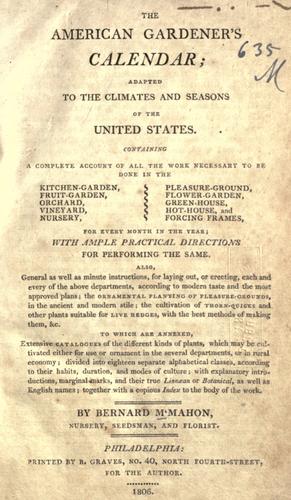
The American Gardener's Calendar; adapted to the Climates and Seasons of the United States

The American Gardener's Calendar; adapted to the Climates and Seasons of the United States

Bernard McMahon (M'Mahon) · 1806

$550

McMahon's Calendar is the most comprehensive gardening book published in the United States in the first half of the nineteenth century, running to eleven editions between 1806 and 1857. Its author was Thomas Jefferson's gardening mentor and principal seed supplier, and also served as curator for the plants brought back by the Lewis and Clark expedition — which makes the 1806 first edition a cornerstone of both American horticultural and early republic scientific literature. When Bernard M’Mahon arrived in Philadelphia from Ireland in the 1790s, Americans were gardening out of English books written for English weather: mild winters, gentle summers, a calendar that made no sense in Pennsylvania. M’Mahon opened a seed shop and nursery on Second Street and in 1806 published the fix. Month by month, he translated the European kitchen garden for a land of hard frosts and scorching Julys, covering what to sow, when to force it, how to protect it, and how to make vegetables, fruit and flowers succeed in the American climate. He closed the book with what is generally regarded as the first extensive seed catalogue published in the United States, making it part manual and part shop window. It worked. The book stayed the standard American authority for half a century, through eleven editions. The botanist Thomas Nuttall named the genus Mahonia for him. Don’t miss the big folding table in the back: a comparison of the “progress of vegetation” in Pennsylvania with that of Europe’s great wine countries. It’s America’s kitchen-garden declaration of independence.

[ SOMEBODY SHOULD BUY THIS ]
Traité sur la culture et les usages des pommes de terre, de la patate et du topinambour. Publié & imprimé par ordre du Roi

Traité sur la culture et les usages des pommes de terre, de la patate et du topinambour. Publié & imprimé par ordre du Roi

Antoine-Augustin Parmentier · 1789

$4,442

Parmentier's 1789 Traité is the culminating statement of the campaign that made the potato an accepted human food in France, issued "par ordre du Roi" on the eve of the Revolution and extending to the sweet potato and Jerusalem artichoke as famine foods. In the 1760s most of France was sure the potato caused leprosy and was fit only for pigs. Antoine-Augustin Parmentier knew better, because as an army pharmacist captured by the Prussians in the Seven Years’ War he had lived on them. After the famine of 1770 he made converting France his mission. This book, printed by the royal press, is his scientific case: a survey of the plants that could feed people when the wheat failed, with the potato at its center, covering how to grow it, store it, make bread and starch from it, and cook it. Then he turned to publicity. He persuaded Louis XVI to wear potato flowers in his buttonhole, served an all-potato dinner to Benjamin Franklin and Lavoisier, and, according to legend, had a field of potatoes conspicuously guarded by day and left unguarded at night so Parisians would steal them. The folding plate shows a mill for grating potatoes into starch. Bound with it is Parmentier’s later treatise on maize, which the seller calls the first book in Europe devoted to the crop. Every hachis Parmentier on a French menu begins here. The 1789 Barrois printing is recorded in institutional catalogues with the collation this copy matches (viii, 389 [recte 392] pp., 8vo), and it remains a cornerstone title for both agricultural science and gastronomic bibliography.

Hunter's lesson

Of Pirates and Pen Names

When a listing says “first edition,” it’s making a claim, and two quirks of early publishing can make that claim surprisingly hard to check. The first is piracy. La Quintinie’s great manual appeared in Paris in 1690, published by his son two years after the gardener’s death. Within two years an Amsterdam printer had copied it, and other unauthorized editions followed. Meanwhile the authorized publishers kept issuing new editions of their own, so in 1697 a buyer could have found both a legitimate Paris printing and a pirated Amsterdam one. One of those Amsterdam copies is listed right now as an “édition originale.” It’s a lovely book, but it’s not an original. The clues are in the imprint and the format: the authorized editions kept the large quarto of 1690, while the Amsterdam copies are noticeably smaller. Piracies are well worth owning, as evidence of how fast and how far a book traveled. They just shouldn’t be priced as firsts. The second is the name on the title page, which often isn’t the author’s. Early authors hid behind initials, pseudonyms and other people’s reputations. Evelyn signed Acetaria only “J.E.” Thomas Tryon issued his vegetarian manifesto in 1683 as “Philotheos Physiologus,” and when it reappeared under his real name in 1691, it was called a second edition. Every Man His Own Gardener went out under the name of Thomas Mawe, who was paid twenty guineas for the use of it, while the real author, John Abercrombie, waited nine years to claim his book. The result is that a single text can be catalogued under two or three names, and the earliest version is often filed under the one nobody searches for. Libraries put the real name in brackets, and reference works on anonymous and pseudonymous literature untangle the rest. Search every name a book has gone by. So ask three questions. First of what? Printed by whom? Under whose name? The answers rarely change whether a book is worth reading. They often change what it’s worth paying.