 [ THE WEIRD ONE ]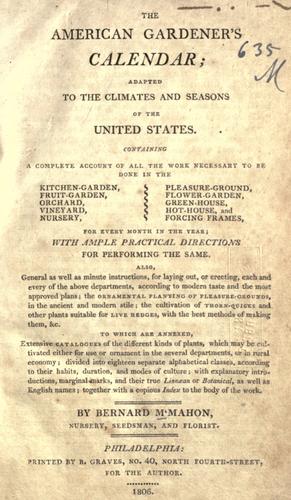
The American Gardener's Calendar; adapted to the Climates and Seasons of the United States
Bernard McMahon (M'Mahon) · 1806
$550
Why it matters
McMahon's Calendar is the most comprehensive gardening book published in the United States in the first half of the nineteenth century, running to eleven editions between 1806 and 1857. Its author was Thomas Jefferson's gardening mentor and principal seed supplier, and also served as curator for the plants brought back by the Lewis and Clark expedition — which makes the 1806 first edition a cornerstone of both American horticultural and early republic scientific literature. When Bernard M’Mahon arrived in Philadelphia from Ireland in the 1790s, Americans were gardening out of English books written for English weather: mild winters, gentle summers, a calendar that made no sense in Pennsylvania. M’Mahon opened a seed shop and nursery on Second Street and in 1806 published the fix. Month by month, he translated the European kitchen garden for a land of hard frosts and scorching Julys, covering what to sow, when to force it, how to protect it, and how to make vegetables, fruit and flowers succeed in the American climate. He closed the book with what is generally regarded as the first extensive seed catalogue published in the United States, making it part manual and part shop window. It worked. The book stayed the standard American authority for half a century, through eleven editions. The botanist Thomas Nuttall named the genus Mahonia for him. Don’t miss the big folding table in the back: a comparison of the “progress of vegetation” in Pennsylvania with that of Europe’s great wine countries. It’s America’s kitchen-garden declaration of independence.
Why we're looking
At $550 this sits below every other 1806 first edition currently visible on AbeBooks — $850 (Doodletown Farm Books, Good), $900 (Rosenbloom Rare Books, Good), and $1,250 (Zephyr Used & Rare Books, ABAA) — so roughly $300 under the nearest comparable. Notably, the $900 copy is explicitly missing the folding table that this copy retains, albeit torn and chipped; the discount here looks like condition pricing (cracked hinges, foxing, damaged table) rather than a mispricing, but it is the cheapest route into the first edition on the open market right now.
Watch out for
The seller is candid about real structural problems: both hinges cracked, scuffed and edge-worn calf with only a remnant spine label, foxing throughout, and an owner's name on the title. The folding table — torn at the gutter in two places and chipped at the fore-edge — is the main value question, since another ABAA dealer's copy of this edition records one large folding table ("Of the progress of vegetation in Pennsylvania...") plus a text diagram for planting hyacinth bulbs; worth asking whether that diagram is present and whether the table is complete apart from the chip. No image accompanies the listing, so request photographs of the hinges, the title, and the table before committing.