Issue No. 6 · October 5, 2026

Old Book Hunter #6

As a tribute to the massive construction projects taking place around Brooklyn's Gowanus canal, this issue is about toxicity. Paracelsus put it best: the dose makes the poison. Everything is toxic in the right amount, and for most of history no one could say what that amount was, or prove after a death that it had been crossed. This issue follows the century in which that began to change. It opens in 1702 with a young London physician studying viper venom under a microscope and trying to explain it like Newton. It visits a royal rat-catcher who poisoned for a living, and an East India Company naturalist sorting the deadly snakes of India from the harmless ones. It closes with two men who dragged poison into public view: Orfila, who taught the courts how to find arsenic in a body, and Accum, who found poisons in London's bread, beer and cheese, and named the merchants who put them there. Five books, 1702 to 1820, from the laboratory to the courtroom to the kitchen table.

[ THE BARGAIN ]
Traité des poisons tirés des règnes minéral, végétal et animal, ou toxicologie générale

Traité des poisons tirés des règnes minéral, végétal et animal, ou toxicologie générale

Mathieu Joseph Bonaventure Orfila (1787–1853) · 1818

$228

Orfila's Traité des poisons, issued in two volumes in 1814–15, is the founding systematic treatise of experimental toxicology, and he is routinely described in the medical-history literature as the founder of modern toxicology. He set out to classify every known poison by its source (mineral, vegetable, animal), its symptoms, its antidotes and, crucially, how to find it in a body. His animal experiments were exhaustive. Two decades later Orfila was in the witness box at the sensational Lafarge arsenic trial of 1840. Every courtroom poisoning case since owes him something. This 1818 Crochard printing is the revised and enlarged second edition of that work, issued while Orfila was establishing himself in Paris.

[ THE SLEEPER ]
A Mechanical Account of Poisons in Several Essays

A Mechanical Account of Poisons in Several Essays

Richard Mead (1673–1754) · 1702

$750

Mead's first published book, it is described by the US National Library of Medicine as the first book in English devoted entirely to poisons, built on his own experiments — including tasting viper venom — and framed within the iatrophysical (mechanical) explanation of how poisons act on the body. The essays cover viper venom, the mad dog's bite, the tarantula, poisonous minerals and plants, and opium, making it a foundational text of experimental toxicology and a cornerstone of Mead's later career as one of London's most eminent physicians. Much of his theory is wrong, but the method points forward: poison as something to be observed, tested and explained. Mead went on to assemble one of the great libraries of his age. This is where the career started. It's an early landmark in the English literature on poisons, and the folding plate is a bonus.

[ THE BEAUTIFUL ONE ]
An Account of Indian Serpents, Collected on the Coast of Coromandel; containing descriptions and drawings of each species; together with experiments and remarks on their several poisons

An Account of Indian Serpents, Collected on the Coast of Coromandel; containing descriptions and drawings of each species; together with experiments and remarks on their several poisons

Russell, Patrick (1726/7–1805) · 1796

Price on listing ↗

Russell's folio is the first published work devoted to the snakes of India, produced after his appointment as botanist to the East India Company in the Carnatic, and it grew out of a practical public-health aim — giving residents a reliable way to tell venomous species from harmless ones. It is also a landmark of late-Georgian colour-plate natural history, printed by William Bulmer for George Nicol. The plates are hand-coloured and life-scaled, and the experiments on the "several poisons" are built right into the title. Russell drew heavily on Indian snake-handlers' knowledge and then tested it, and the book stands behind the naming of Russell's viper (Daboia russelii); auction cataloguers cite it under the standard references Nissen ZBI 3539 and Wood p. 547. The catch is that this copy lives in New Delhi and can't leave India.

[ THE WEIRD ONE ]
The Universal Directory for Taking Alive and Destroying Rats, and all other Kinds of Four-Footed and Winged Vermin

The Universal Directory for Taking Alive and Destroying Rats, and all other Kinds of Four-Footed and Winged Vermin

Robert Smith (rat-catcher to Princess Amelia) · 1768

$464

Smith's manual is the best-known English pest-control book of the eighteenth century, written by a working exterminator who styled himself rat-catcher to Princess Amelia, daughter of George II, and it treats roughly forty species of "vermin" with practical trap designs illustrated in engraved plates. Institutional records credit the engravings to Thomas Bowen and record the edition as ESTC T132212, making it a documented landmark of trade and agricultural literature rather than a mere curiosity. It's also a reminder that in Georgian England, poisoning was a trade as well as a crime, practised daily in kitchens, barns and royal households.

[ SOMEBODY SHOULD BUY THIS ]
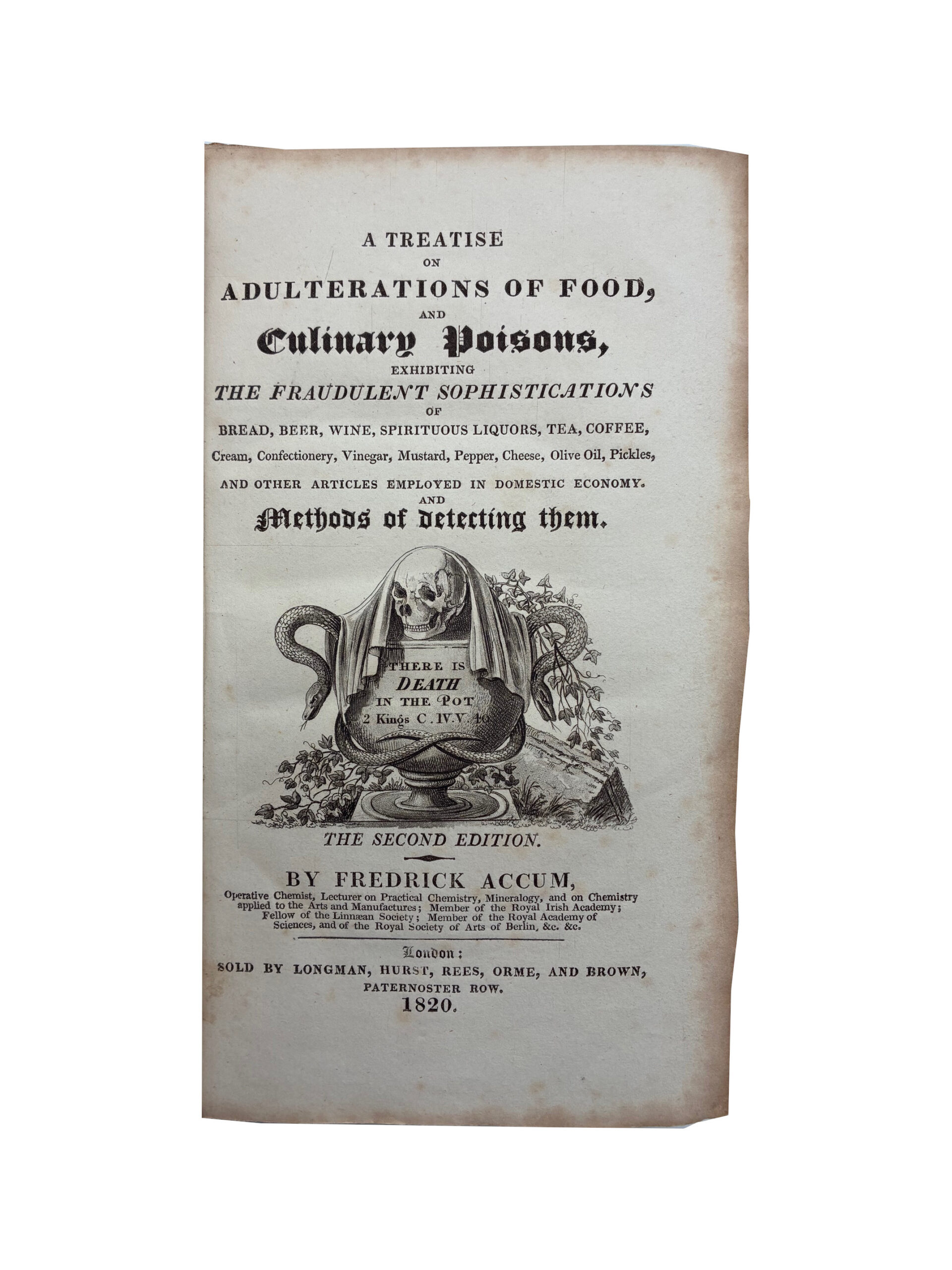
Death in the Pot: A Treatise on Adulterations of Food, and Culinary Poisons, Exhibiting the Fraudulent Sophistications of Bread, Beer, Wine, Spirituous Liquors, Tea, Coffee, Cream, Confectionery, Vinegar, Mustard, Pepper, Cheese, Olive Oil, Pickles, and Other Articles... Second edition

Death in the Pot: A Treatise on Adulterations of Food, and Culinary Poisons, Exhibiting the Fraudulent Sophistications of Bread, Beer, Wine, Spirituous Liquors, Tea, Coffee, Cream, Confectionery, Vinegar, Mustard, Pepper, Cheese, Olive Oil, Pickles, and Other Articles... Second edition

Frederick Accum (Friedrich Christian Accum, 1769–1838) · 1820

$497

"There is death in the pot." Accum borrowed the line from 2 Kings and turned it into the most sensational science book of 1820. A German chemist working in London, he bought ordinary groceries and tested them. He found alum in the bread, red lead in the cheese, copper in the pickles, sulphuric acid in the vinegar, and narcotic berries in the beer. Then he named names. His most quoted line still lands: the highway robber who steals a few shillings is hanged, "while he who distributes a slow poison to a whole community, escapes punishment." The first edition sold out within weeks, and this second edition followed the same year. Within a year Accum himself had fled England amid a scandal over pages cut from Royal Institution library books, which some saw as payback from the merchants he'd exposed. Accum's Treatise is routinely treated as the starting point of modern food-safety awareness in Britain. The first edition appeared in January 1820 and this second edition followed within months the same year, a reflection of how fast the book sold.

Hunter's lesson

Cultural Property

This issue's most beautiful book, Patrick Russell's Indian Serpents, comes with a line most buyers never see: "Exportable: No." Under India's Antiquities and Art Treasures Act, objects over 100 years old, and manuscripts of historical or literary value over 75, generally can't leave the country without government permission, which is rarely given. The copy is real and for sale. It just has to stay in India. At the high end this is routine. Britain can put a temporary export bar on a book of national importance to give a domestic institution time to match the price. Italy requires an export certificate for older cultural goods and can refuse one. France can declare an object a trésor national. These rules mostly affect five- and six-figure books, and reputable dealers handle the paperwork. Lower down, it gets murkier. Search eBay for "Ethiopian Coptic Bible" and you'll find parchment manuscripts, usually in Ge'ez (the "Coptic" label is a trade misnomer), in wooden boards, often at tempting prices. Some are recent devotional or tourist work. Others may have left a church or monastery that never meant to part with them, and Ethiopian law restricts the export of such heritage objects. Similar caution applies to manuscripts from Iraq, Syria, Yemen, and Tibet. Our rule is simple: the older and more culturally specific the object, the more the paperwork matters. Ask where it came from, when it left, and whether it left legally. A seller who can't answer those questions is telling you something.