Issue No. 4 · September 18, 2026

Old Book Hunter #4

There's a reason probability theory feels newly urgent. Prediction markets have gone mainstream and game theory sits at the center of how modern AI systems are actually trained to make better bets under uncertainty. This is the same problem three authors featured here, Pothier, Hoyle, and De Moivre, were each circling from a different direction nearly three centuries ago. This issue is built around the concept of chance. It contains: the founding text of probability theory itself, dedicated to Newton and still cited in the DNA of every model that calculates an expected value today; a chess treatise from the player who demonstrated the importance of the pawn and whose name is still attached to openings played at grandmaster level; a card-game rulebook so authoritative its author personally hand-signed thousands of copies to fight counterfeiters, and gave the English language the phrase "according to Hoyle"; a comprehensive 18th-century insurance digest that name-drops the actual mathematicians of probability directly in its pages; and a French jurist's attempt to draw a legal line between insurance and gambling before the math existed to draw one. None of these people had our vocabulary. All of them were doing the same fundamental work: trying to reason clearly about outcomes they couldn't fully control. If any of it catches your eye, the full write-up — including why it matters and what to watch for — is one click away.

[ THE BARGAIN ]
Traités des contrats aléatoires, selon les règles tant du for de la conscience que du for extérieur (including the Traité du jeu)

Traités des contrats aléatoires, selon les règles tant du for de la conscience que du for extérieur (including the Traité du jeu)

Robert-Joseph Pothier (1699–1772) · 1770 per the listing; the work's original edition appeared in 1767

$195

Pothier is arguably the single most influential French legal mind of the 18th century — not because his own work was flashy, but because it was so systematic and clearly reasoned that it became the direct template for how French law got codified a generation later. When Napoleon's jurists sat down to draft the Code Civil, Pothier's treatises weren't background reading; they were working source material, lifted from almost verbatim in places. This particular treatise takes on a genuinely tricky legal category: aleatory contracts, meaning any agreement where the outcome depends on chance — insurance, annuities, and, directly, wagers. Pothier's inclusion of a dedicated treatise on gambling within this same legal framework is exactly the point: 18th-century law didn't yet have a clean way to separate "legitimate risk-sharing" from "a bet," and Pothier was one of the people doing the intellectual work of drawing that line. Two and a half centuries later, insurance law still runs on distinctions he helped articulate.

[ THE SLEEPER ]
A Complete Digest of the Theory, Laws, and Practice of Insurance

A Complete Digest of the Theory, Laws, and Practice of Insurance

John Weskett · 1783

$450

By the 1780s, insurance and gambling were not clearly separate things under English law, and that ambiguity had real consequences — people were taking out "insurance" policies on the lives of strangers, on the outcomes of wars, even on whether a particular ship would return, essentially placing bets dressed in legal language. Weskett's Complete Digest was one of the first serious attempts to systematically sort out what insurance actually was, as a matter of law, and what it wasn't. The book opens with an 80-page critical essay proposing reforms to correct what Weskett calls the "very great disorders" in how insurance was practiced, before moving into an alphabetically organized digest of the field as it then stood — citing, by name, the leading theorists of risk and probability of the age: Richard Cantillon, Malachy Postlethwayt, Abraham de Moivre, and Richard Price. That last name is worth sitting with for a second: Price was the actuary who, working from Bayesian principles, helped found the mathematical basis of modern life insurance. A book that puts Weskett's practical legal reforms in direct conversation with De Moivre and Price is a book standing exactly at the hinge between two histories that don't usually get told together — the history of probability as mathematics, and the history of insurance as law.

[ THE BEAUTIFUL ONE ]
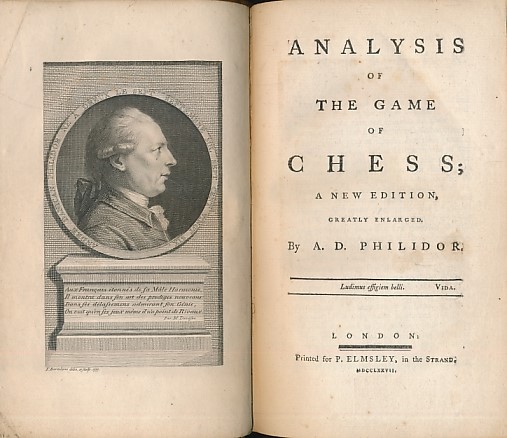
Analysis of the Game of Chess; A New Edition, Greatly Enlarged

Analysis of the Game of Chess; A New Edition, Greatly Enlarged

François-André Danican Philidor · 1777

$1,299

Philidor didn't just write a chess book — he invented modern positional chess theory. Before Philidor, chess strategy was largely about piece-by-piece tactical combinations; his famous line, "pawns are the soul of chess," reoriented the entire game around long-term structural planning. That reorientation stuck so completely that his name is still attached to specific openings and endgame positions taught to beginners today — "the Philidor Defense," "the Philidor Position." He was also, by all contemporary accounts, simply the best player in the world for decades, reportedly capable of playing multiple games blindfolded simultaneously, a feat considered nearly unbelievable at the time. This 1777 edition is Philidor's own expanded revision of his original 1749 text, meaning it reflects his mature thinking, not his first attempt — the book that a serious 18th-century player would actually have studied from.

[ THE WEIRD ONE ]
A Short Treatise on the Game of Whist [bound with] A Short Treatise on the Game of Quadrille; ... Piquet; ... Back-Gammon

A Short Treatise on the Game of Whist [bound with] A Short Treatise on the Game of Quadrille; ... Piquet; ... Back-Gammon

Hoyle, Edmond · 1750

$1,438

Hoyle didn't just write rules down — he invented the entire genre of "the authoritative rulebook" for a game, and did it so thoroughly that his name became a common noun. "According to Hoyle" entered everyday English as shorthand for playing by the correct, official rules, a linguistic fossil of just how total his authority was in his own lifetime. Before Hoyle, card game rules were an oral, regional, constantly-disputed mess; after Hoyle, whist had a single, citable standard that clubs and private houses across England actually deferred to. His 1760 revision of the laws of whist remained the accepted standard for over a century, until a formal club finally superseded it in 1864. This volume bundles four of his treatises together — whist, quadrille, piquet, and backgammon — making it a genuine snapshot of exactly what educated 18th-century England was sitting down to play.

[ SOMEBODY SHOULD BUY THIS ]
The Doctrine of Chances: or, A Method of Calculating the Probability of Events in Play

The Doctrine of Chances: or, A Method of Calculating the Probability of Events in Play

Abraham de Moivre · 1718

$10,406

This is the book that turned "the mathematics of gambling" into "probability theory" as a formal discipline. De Moivre had presented an early version of the work to the Royal Society in 1711; by 1718 he'd expanded it into the first true textbook on the subject in English, dedicated to his close friend Isaac Newton. Within its pages are the first clear statements of ideas so foundational that most people who use them today have no idea they originated here — conditional probability, the multiplication rule for independent events, expectation itself as a formal concept. In a later edition, De Moivre would go on to derive an early form of what we now call the central limit theorem, one of the single most important results in all of statistics. Everything from actuarial science to modern risk modeling has a direct lineage back to this book — De Moivre and Edmund Halley are jointly credited as founders of the field of actuarial science itself. It's not an exaggeration to say this is the moment "gut feeling about luck" became "mathematics."

Hunter's lesson

When a Later Edition Might be More Collectible

De Moivre didn't write The Doctrine of Chances in a vacuum. Ten years before it appeared, Pierre-Rémont de Montmort had already published the first standalone book ever devoted to probability — and when De Moivre's version came out, Montmort was furious, believing his own solutions were being outdone without proper credit. The two argued in print for years, a rivalry only settled by Montmort's early death in 1719. That fight actually mattered to the math. De Moivre kept revising his book across three editions, and each pass added real content pushed partly by a rival who wouldn't let him rest — new generalizations, tighter proofs, and eventually a version of what we now call the central limit theorem, one of the most important results in the entire history of statistics. None of that existed in 1718. In a similar pattern, Philidor's chess treatise in this week's lineup is a second edition, not his first. Philidor kept revising his own analysis across his lifetime as his understanding of the game deepened, and the 1777 text reflects real, mature refinements his original 1749 attempt didn't yet have. Newton's own Principia, arguably the most important scientific book ever printed, only gained its famous "hypotheses non fingo" passage — Newton's explicit statement that he doesn't invent explanations he can't prove — in the second edition of 1713, twenty-six years after the 1687 first. Malthus's population essay went through a similar transformation: the slim, provocative 1798 first edition became, by 1803, a vastly expanded second edition built on real empirical data gathered across Europe, arguably the more serious scholarly achievement even though the first is the far more famous and expensive book to own. None of this means a first edition is somehow the lesser prize — rarity and historical primacy are real, legitimate reasons a first commands the premium it does, and most of the time it should. But before assuming "first" automatically means "best" or "most complete," it's worth asking what an author actually did with the chance to go back. Sometimes the real prize — mathematically, scientifically, even just for interest — is sitting quietly in the edition that came after.