 [ THE BEAUTIFUL ONE ]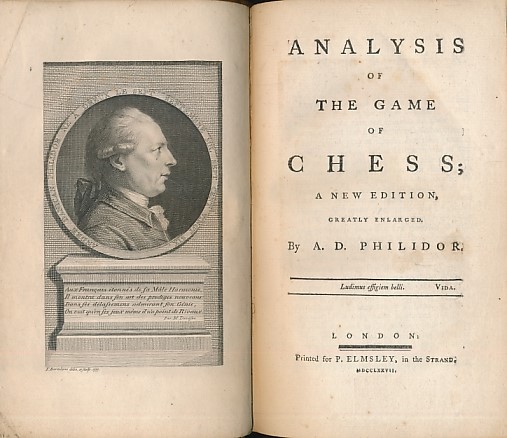
Analysis of the Game of Chess; A New Edition, Greatly Enlarged
François-André Danican Philidor · 1777
$1,299
Why it matters
Philidor didn't just write a chess book — he invented modern positional chess theory. Before Philidor, chess strategy was largely about piece-by-piece tactical combinations; his famous line, "pawns are the soul of chess," reoriented the entire game around long-term structural planning. That reorientation stuck so completely that his name is still attached to specific openings and endgame positions taught to beginners today — "the Philidor Defense," "the Philidor Position." He was also, by all contemporary accounts, simply the best player in the world for decades, reportedly capable of playing multiple games blindfolded simultaneously, a feat considered nearly unbelievable at the time. This 1777 edition is Philidor's own expanded revision of his original 1749 text, meaning it reflects his mature thinking, not his first attempt — the book that a serious 18th-century player would actually have studied from.
Why we're looking
A genuine 1777 London printing at roughly $1,299 (converted from £960 by the seller), with what the seller describes as period manuscript annotations, is the kind of working-copy association that separates one copy from another. No directly comparable priced copy of the 1777 English edition turned up in search — the auction records I found were either mixed lots without visible prices or the 1749 French first edition.
Watch out for
The seller's own collation reads [ii], 306, [vi] pp., while the British Library / ESTC-derived record for the 1777 Elmsley printing gives [6], 306, [6] pp. with a half-title — so the preliminaries may be short by two leaves, or simply counted differently, and it is worth asking whether the half-title survived the modern rebinding. The listing also states plainly that this is a modern rebind with new endpapers, which removes original binding and any endpaper provenance, and notes slight foxing. With no image supplied, the "18th-century hand" annotation claim rests entirely on the seller's word and should be photographed before purchase.